
From the Storage is a recurring exhibition format where the gallery team selects and presents remarkable works from private collections and the gallery’s storage, highlighting different artists, periods, and artistic approaches through each edition.
The sixth edition focuses on Valentin Stefanoff, is one of the most established and influential figures in contemporary Bulgarian art. Bringing together a carefully curated selection of works from different periods of the artist’s career, the exhibition offers an opportunity to trace the development of Stefanoff’s distinctive artistic language over the years.
Alongside key works from previous series, the exhibition premieres Microphilia, a new body of work that continues the artist’s exploration of the relationships between nature, matter, perception, & scale.
Installation view

Artworks
Microphilia
The Microphilia series marks Valentin Stefanoff’s return to oil painting on canvas after a long hiatus. While the medium has changed, his way of thinking remains the same: an analytical gaze and a sustained interest in structure continue to form the foundation of his creative process.
In this series, the artist turns his attention to microscopic objects from the world of contemporary technology—processors, electronic circuit boards, and computer components. Greatly enlarged and detached from their original function, these elements are transformed into autonomous visual forms. By altering their scale, Stefanoff draws attention to details that usually remain unnoticed, endowing them with new visual and conceptual significance.
As in his earlier works, beauty here emerges through meticulous observation. Rather than seeking symbolic meaning, the artist explores the form, rhythm, and internal organization of these objects. Microphilia is an investigation of the unseen—an invitation to look closely at what surrounds us every day yet rarely becomes an object of contemplation.

MICROPHILIA #1
2022
Oil on canvas
100 × 100 cm

MICROPHILIA #2
2022
Oil on canvas
100 × 100 cm
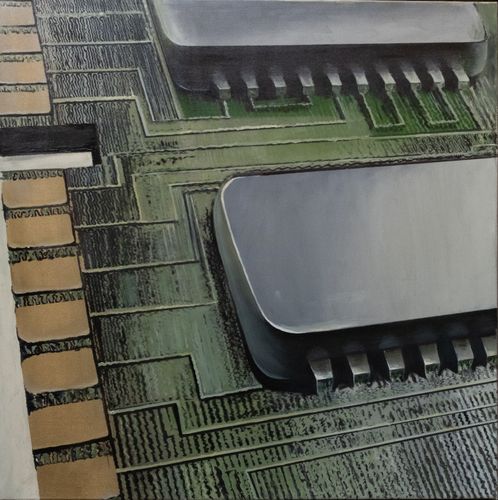
MICROPHILIA #3
2022
Oil on canvas
100 × 100 cm

MICROPHILIA #4
2022
Oil on canvas
100 × 100 cm

MICROPHILIA #5
2022
Oil on canvas
100 × 100 cm

MICROPHILIA #6
2022
Oil on canvas
100 × 100 cm

Open Closed #1, 1997-1998
Mixed media on Plexiglas
50 х 87 cm

Open Closed #2,1999-2000
Mixed media on Plexiglas
80 х 80cm

Open Closed #3, 1999-2000
Mixed media on Plexiglas
80 х 120cm
Open Closed Series
Harmony and logic, aesthetics and mathematics are brought together in the work of Valentin Stefanoff. These seemingly opposing principles are organically interwoven, and although the individual elements of this unity can often be distinguished, the overall impression of harmonious refinement is always preserved. The artist possesses a remarkable ability to observe and analyze his impressions directly within the process of making the work itself. He is drawn to the mystically perfect formula, the aesthetic elegance of a completed scientific concept, and the possibility of transcending the divide between artistic intuition and rational thought.
His works are carefully conceived and executed with exceptional precision and a profound respect for detail. They seem to investigate the boundary between creativity and other human faculties while revealing their inherent interconnectedness. At the same time, each work by Valentin Stefanoff conveys the impression of belonging to a larger process—a fragment of a broader intellectual system in which technical logic and constructive order ultimately give way to the freedom of personal choice, independent thought, and individual decision-making. At times, the artist creates the illusion that the creative process unfolds effortlessly, disarming the viewer through an apparently transparent methodology and his characteristic use of transparent materials. A closer examination, however, reveals that these methods are deeply personal and founded upon patience, discipline, and perseverance.
Stefanoff succeeds in transforming the external dynamism of life into a state of concentrated equilibrium. In the Open Closed series (mixed media on Plexiglas, mounted 5 cm from the wall, 1999–2000), space becomes a metaphor for the chaos of nature, while illusion emerges as its inherent beauty. Space is one of the defining elements of his artistic language: it structures the composition regardless of the medium employed and serves as a generator of meaning. The relationship between space—with the artist’s delicate interventions, which often appear almost self-generated—and time, an acknowledged participant in his works, achieves a remarkable balance. The experience often evokes subtle musical phrases recalled in the stillness of the night, gradually unfolding into a complete melody.
Valentin Stefanoff works with an exceptionally broad range of materials, continuously discovering new possibilities even within the most traditional techniques. Years ago, he undertook bold experiments with the demanding medium of etching before introducing transparent and coloured Plexiglas into his graphic works. Plexiglas enabled these works to evolve beyond two-dimensional images into installations projecting from the wall toward the viewer, creating distinctive magnetic spaces that retain both aesthetic sensitivity and formal refinement. His practice has increasingly focused on the world of visual illusion, the enigmatic relationship between an object and its shadow, and the timeless triad of past, present, and future. In these works, Stefanoff explores the almost demiurgic capacity of art to move between reality and illusion, and back again. Through his installations, he seeks to materialize phenomena that seem attainable only through language and its infinite expressive potential.
Valentin Stefanoff belongs to that rare group of uncompromising artists who continually challenge and redefine their own means of expression, transforming them into something unmistakably personal and resistant to imitation. Among his later explorations are works in video art and digital montage. With his characteristic economy of means, he constructs a compelling visual metaphor for contemporary life—with its obsessive and self-destructive impulses, yet also its persistent drive toward reconstruction and renewal. Rather than relying on literary narrative, he reduces it to a contextual framework for his own observations. His articulate visual language neither seeks to intervene in reality nor merely to play with its material presence. Instead, it remains firmly rooted in lived experience and in the artist’s deeply cultivated ability to perceive the dialectics of things, uncovering meanings that have long outlived their original forms.

We the poor of this world… ,
2014, video 06,50 min.
A: We the poor of this world…
B: In the West, the weather is bright and brightening. Mostly sunny, with intermittent rain showers here and there.
A: …we have nothing and we have everything, not here and now, not there and then, but everywhere and forever.
C: The shops are full, the restaurants are full, the filling stations are full, God’s great ocean is full of paid vacationers.
A: We don’t have the logos, for the logos was at the beginning of time; whoever has the logos is in possession of time.
D: By empowering (овластяване) your employees (служители) and cultivating happy customers, you’ll be in a much stronger position to retain (запазвам), to up-sell and to drive success among your customers.
A: No, we don’t want anything to do with the logos, for it is also at midday, the midday of history.
E: At the end of history, the nation will continue to be a central pole of identification, even if more and more nations come to share common economic and political forms of organization.
A: The logos feeds the simulacra that engender (предизвиквам) the phony (фалшиф) depth of phony concepts like justice and equality.
F: In a little time I began to speak to him; and teach him to speak to me: and first, I let him know his name should be Friday, which was the day I saved his life: I called him so for the memory of the time. I likewise taught him to say Master; and then let him know that was to be my name.
A: We the poor have a deep aversion (антипатия) to depth. We know the surface is deeper than any depth.
G: You have been given to know the secrets of the kingdom of God; but to others I speak in parables (притчи) so that seeing they may not perceive (възприемам), and listening they may not understand.
A: We are happy to indicate simple matters like pleasure and pain. Let the rich fools pretend to be manifesting the complexity of truth. We’ll keep preaching to the birds.
H: Again, truth should be highly valued; if, as we were saying, a lie is useless to the gods, and useful only as a medicine to men, then the use of such medicines should be restricted to physicians; private individuals have no business with them.
A: The rule is, jam to-morrow and jam yesterday – but never jam to-day.
I: The fifth weekend of summer holidays in Europe is traditionally synonymous with epic traffic jams. As Belgians, Italians French, Germans and Dutch depart on holiday or attempt to make their way back home en masse, the European highways are the site of record kilometers of bumper-to-bumper cars. Saturday, France is expecting massive traffic jams direction south.
Text written and read by Lubomir Terziev
The text features quotations from the:
News reports
Howard Nemerov; Boom
A business manual
Francis Fukuyama, The End of History and the Last Man
Daniel Defoe, The Adventures of Robinson Crusoe
The New Testament
Plato, The Republic, Book III
Lewis Caroll, Through the Looking Glass, and What Alice Found There.

Light on Edge
2014 video, 04,15 min.

Nothing full of nothing
2013, video 02,30 min.
The silence and the uncertain usefulness of things within the temple compel us to lift our gaze and offer a prayer to that Something which encompasses all things—God.
The noise and the obsolete usefulness of things within this post-industrial landscape compel us to lift our gaze and offer a prayer to that Nothing which lies at the foundation of every nothing—God.
In either case, nothing moves.

Sometimes Closed is More Open than Open and Open is More Closed then Closed
2008, video 05,00 min.
About the artist
Valentin Stefanoff is born 1959 in Sofia. He lives and works in Paris, France. In 1985 Valentin Stefanoff graduated from The National Art Academy, Sofia, Bulgaria.
Valentin Stefanoff’s works have been exhibited in numerous galleries and museums, including:
Musée d’Art Moderne et Contemporain de Saint-Étienne, France; Musée d’Art Moderne et Contemporain de Strasbourg, France; National Museum of Contemporary Art (MNAC), Bucharest, Romania; Sofia Arsenal – Museum of Contemporary Art, Sofia, Bulgaria; National Art Gallery, Sofia, Bulgaria; Sofia City Art Gallery, Sofia, Bulgaria; Museum of Contemporary Art Taipei, Taiwan; Zendai Museum of Modern Art, Shanghai, China; Zona Center for Art, New York, USA; Nuit Blanche, Paris, France; National Museum, Poznań, Poland; Jeju Museum of Art, Jeju, South Korea; National Gallery of Macedonia, Skopje, North Macedonia; MOMus – Metropolitan Organisation of Museums of Visual Arts, Thessaloniki, Greece; Esterházy Contemporary Foundation, Austria; Kunsthalle Hannover, Germany; KULTUM Museum, Graz, Austria; Structura Gallery, Sofia, Bulgaria; and the Museum of Contemporary Art Belgrade, Serbia.
In 2002, for the video installation In the Out, created in collaboration with Nina Kovacheva, Valentin Stefanoff received UNESCO’s Annual Award for the Promotion of the Arts.